Those Orange Things In The Back
Timpani For Percussionists
Timpani for bass drummers
If the bass drum is your primary percussion instrument, the good news is you're going to have the easiest time fitting into the music, as timpani and bass drum often perform very similar functions. The bad news is that you will have to adjust a lot of your technique. Timpani requires both hands, is usually hit in different part of the drum, and requires note reading, not just rhythm reading. And, while not usually as technically challenging as snare drum music, most timpani parts are more complex than most (non-marching) bass drum parts.
Consider this typical bass drum pattern-

Now here's what that same pattern looks like on the two largest timpani in the key of Bb. The big drum needs tuned to F (the note hanging off the bottom of the staff) and the second biggest drum needs to be tuned to Bb (the note on the second line of the staff)-

Here's that same pattern in three drums-

And four-

Now consider a typical bass drum part in a march, where you'd just be playing steady quarter notes through almost the entire piece-
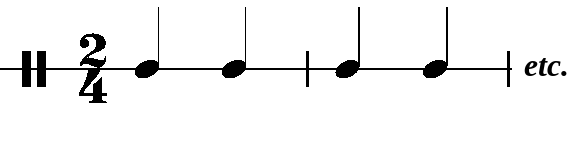
In the same music, timpani will often be playing the same rhythm, but between two or three drums-


These videos show the musical examples on this page, first on bass drum, then on timpani
You can download all of the musical examples on this site as a pdf here. This includes more examples for bass drum, in addition to the exercises for snare drum, quads, and mallet percussion., all presented with their timpani equivalents immediately below. You may also wish to check out the care and maintenance page.