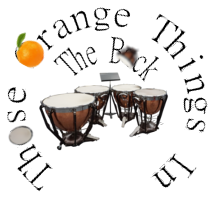
Those Orange Things In The Back
Timpani For Percussionists
History Of The Timpani
The timpani are some of the oldest instruments still in use in the modern concert band and orchestra, but like most of the other instruments they've changed a LOT from their earliest incarnations. The first ancestors of the timpani were middle eastern drums called the naqqarah, or in English the naker. These drums were much smaller and higher pitched than the modern timpani, and made of baked clay shells and calf skin or goat skin heads. Such drums are still used today in the Middle East and India, like in this example-
The naker were brought back to Europe during the Crusades, first appearing in Western music in the 1200s...although no written timpani music exists before the 1600s! For the first several hundred years of its western history, timpani manufacture and technique were closely guarded guild secrets, and timpani were only to be played for royalty. Gradually they made their way into the orchestra, and later into military and concert bands. Many major composers featured important parts for timpani in their works, including Beethoven, Berlioz, and Holst.

These composers were only able to write more for timpani because the instruments were improving. The bowls shifted over time from being constructed out of clay to being made of copper. The heads transitioned from being nailed to the drum, to being set in a hoop using screw lugs. This allowed timpani to be tuned to definite pitch, allowing them to become part of the harmony of the band, not just the rhythm. By the 17th century, they looked like this (original image)-
 And, most importantly, pedal tuning was developed first by August Knocke in Munich, Germany in 1840, and later refined by Carl Pittrich and Paul Focke in Dresden, Germany, in the late 1870s and early 1880s. This finally allowed timpani to play complete melodies and bass lines without the player having to stop and use their hands to retune each drum. Almost all modern timpani are based on the Dresen model foot pedal systems, an early example of which is shown to the left. (original image)
 After further refinement to the foot mechanism, and the introduction of plastic heads, modern timpani generally look like this (original image)-
which is a big change from a clay pot with a calf skin stretched over it!
Now that you know a bit about the history of these instruments, it's time to learn how to play. You may want to start with how to hit the timpani, basic grips, or how to read music for the timpani.