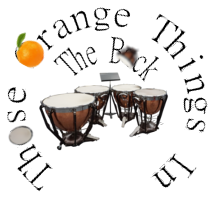
Those Orange Things In The Back
Timpani For Percussionists
Timpani for snare drummers
If snare drum is your primary percussion instrument, switching to timpani will probably require some mental adjustments. On one hand, the rhythms aren't usually nearly as complex-your hands get to move less! On the other hand, you don't just get the luxury of playing one drum at a time anymore. Becoming comfortable with reading notes on a page, and switching drums while you play will be critical. There's also understanding the different role in the music. Snare drum tends to be the "star" of the percussion section section, and sets the style in marches and overtures. Timpani, on the other hand, supports the whole band, and is more like the bass drum or tuba in function.
If reading notes on a staff is new for you, you may want to check out reading timpani music first.
Consider this basic eighth note exercise on snare drum-

Now do that same exercise on the two biggest timpani, tuned to F and Bb-

Practice it several times, switching a bit faster between each drum each time.
This is the same idea with three drums, tuned to F-Bb-D-

And finally with all four drums-

This is a common rhythm in timpani music, written for snare drum first-

Now for 2 timpani-

And now for 4 timpani-

These videos show all the musical examples on this page, first on snare and then on timpani-
You can download all of the musical examples on this site as a pdf here. This includes more examples for snare drum, in addition to the exercises for quads, bass drum, and mallet percussion., all presented with their timpani equivalents immediately below. You may also wish to check out the care and maintenance page.