Those Orange Things In The Back
Timpani For Percussionists
Reading Music For The Timpani
Timpani reads music in the bass clef, the same clef used by the tuba, the string bass and electric bass, the cello, the euphonium (most of the time), the trombone, and the bassoon. Each drum needs to be tuned to a specific note. Most of the time the music will tell you what those notes are, and usually either the drums will stay tuned to the same note for the entire piece or you'll have a lot of rests to make changes. Simpler music usually only calls for two timpani, while more complex music will call for three, four, or even eight drums!
The notes in bass clef are as follows-
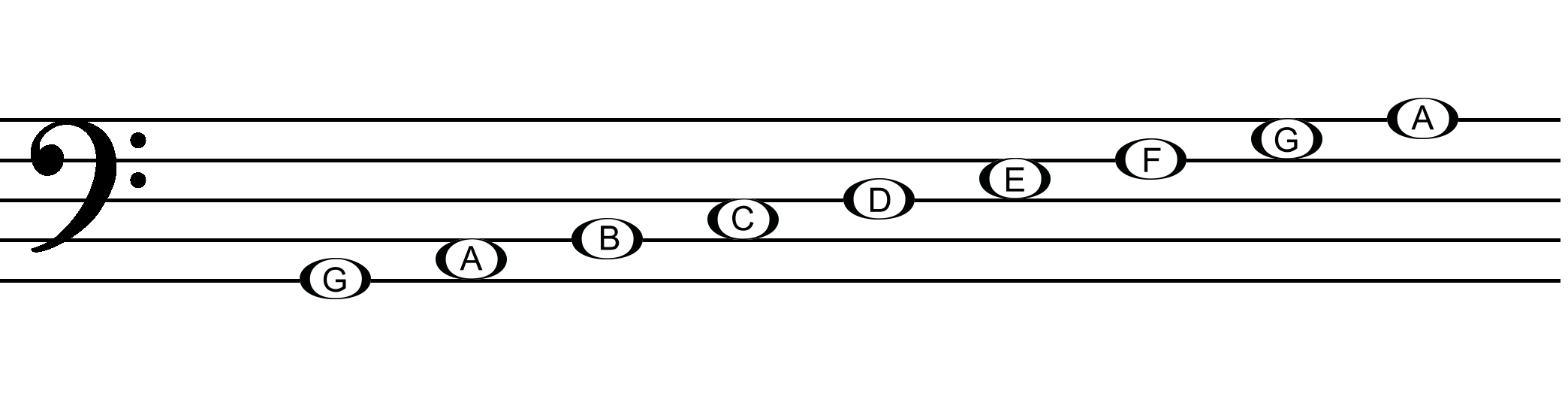
The system can be extended to handle notes that are lower or higher than the staff-
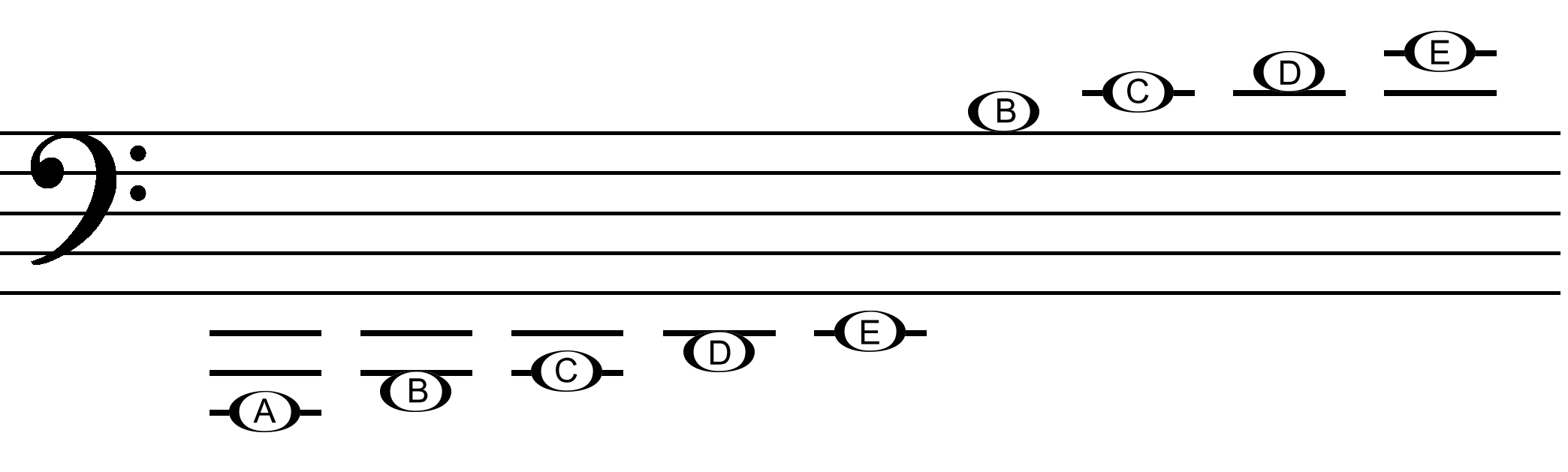
Each drum has a standard range. Notes higher or lower than that range usually won't be written for that drum, especially in band literature, although there are occasional higher note exceptions in advanced and solo music. Note though that the ranges overlap, and many times two different size drums can be tuned to the same note. The music will usually indicate how to tune each drum; when you see letters at the beginning of a section of music (F-Bb-D, for instance) that lists the order from biggest to smallest drum. You'd tune the biggest drum to a low F, the next drum to the Bb above that, and the third drum to D above the Bb.

Which gives the entire standard set of 4 timpani an approximate range of

Now that you have a good idea of where the notes are, you might want to check out tuning the timpani or one of the sections on switching from other percussion instruments.